Martínez Bejines Jesús Activity 4
Martínez Bejines Jesús Activity 4
10 Heat transfert golassary (4) terms
The following are key words or concepts that we must keep in mind for this week's study.
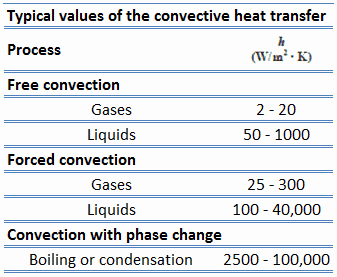
- Convection heat transfer coefficient
- Noun
- The convective heat transfer coefficient, h, can be defined as: The rate of heat transfer between a solid surface and a fluid per unit surface area per unit temperature difference. As can be seen, the constant of proportionality will be crucial in calculations and it is known as the convective heat transfer coefficient, h. The convective heat transfer coefficient, h, can be defined as: The rate of heat transfer between a solid surface and a fluid per unit surface area per unit temperature difference.
- Example: Typically, the convective heat transfer coefficient for laminar flow is relatively low compared to the convective heat transfer coefficient for turbulent flow.
- en: Coeficiente de transferencia de calor por convección
- Critical Reynold’s number
- Noun
- The Reynolds number is the ratio of inertial forces to viscous forces and is a convenient parameter to predict whether a flow condition will be laminar or turbulent. The critical Reynolds number is associated with the laminar-turbulent transition, in which a laminar flow becomes turbulent.
- Example: For practical applications in duct flows, we have that if the Reynolds number for the flow is less than 2000, the flow will be laminar. We also have that if the Reynolds number is greater than 4000, it can be assumed that the flow is turbulent. In the range of Reynolds numbers between 2000 and 4000, it is impossible to predict what type of flow exists; therefore, this interval is known as the critical region.
- en: Número crítico de Reynolds

- Friction Coefficient
- Noun
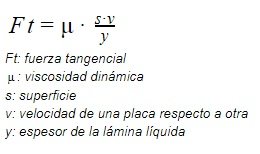
- The coefficient of friction or coefficient of friction links the opposition to sliding offered by the surfaces of two bodies in contact according to the intensity of the mutual support they experience. It is a dimensionless coefficient. It is usually represented by the Greek letter μ (mi).
- Example: Friction is a force that exists between two surfaces in contact and that opposes movement. If the object is pushed, for example, and then left free, this force, also called friction, will be responsible for its speed to decrease or even to slow it down.
- en: Coeficiente de fricción

- Kinematic viscosity
- Noun
- Kinematic viscosity is a measure of the internal resistance of a fluid to flow under gravitational forces. Viscosity can be measured and reported as dynamic (absolute) viscosity or as kinematic viscosity.
- Example: One of the most common instruments for measuring kinematic viscosity is the glass capillary viscometer.
- en: Viscosidad cinemática
- Laminar flow
- Noun
- It is called laminar flows, the movement of a fluid when it is ordered, stratified and smooth. In laminar flow the fluid moves in parallel sheets without intermingling and each fluid particle follows a path called the streamline.
- Example: Re <2000 Laminar Flow: Viscous forces are proportionally stronger than inertial forces. Particles tend to move in streamlines.
- en: Flujo laminar

- Nusselt number
- Noun
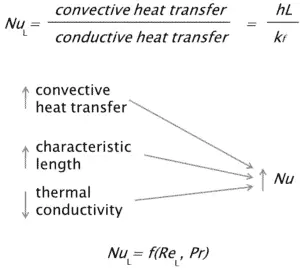
- The Nusselt number (Nu) is a dimensionless number that measures the increase in heat transfer from a surface through which a fluid passes (heat transfer by convection) compared to heat transfer if it occurred only by conduction.
- Example: The Nusselt number equals the dimensionless temperature gradient at the surface, and provides a measure of the convective heat transfer that occurs at the surface.
- en: Número de Nusselt
- Prandtl number
- Noun
- The Prandtl number (Pr) is a dimensionless number proportional to the quotient between the diffusion rate of the amount of moment (viscosity) and the thermal diffusivity.
- Example: In the table on the right, which shows values of the Prandtl number for different materials, it can be seen that liquid metals have very low Prandtl numbers, gases have the particularity of having a Prandtl number around 0.70 , water has an intermediate value, and finally the highest values of the Prandtl number are presented by viscous fluids.
- en: Número de prandtl

- Reynolds number
- Noun
- The Reynolds number (Re) is a dimensionless number used in fluid mechanics, reactor design, and transport phenomena to characterize the motion of a fluid. Its value indicates whether the flow follows a laminar or turbulent pattern
- Example: A flow with a Reynolds number around 100 000 (typical in the movement of a small aircraft, except in areas close to the boundary layer) expresses that the viscous forces are 100 000 times less than the convective forces, and therefore those they can be ignored. An example of the opposite case would be a thrust bearing lubricated with a fluid and subjected to a certain load. In this case the Reynolds number is much less than 1 indicating that now the dominant forces are the viscous ones and therefore the convective ones can be neglected.
- en: Número de Reynolds

- Shear stress
- Noun
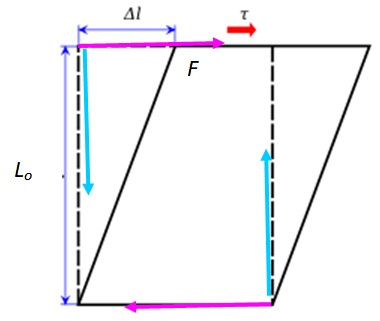
- The shear, shear, shear or shear stress is the internal or resultant stress of the stresses parallel to the cross section of a mechanical prism such as a beam or a column. It is variously designated as T, V, or Q.
- Example: Direct shear forces are applied daily on fabrics, papers or metals, exerted by scissors, guillotines or shears. They also appear in structures such as bolts or screws, dowels, beams, wedges, and welds.
- en: Esfuerzo cortante
- Turbulent flow
- Noun
- In fluid mechanics, turbulent flow is called the movement of a fluid that occurs in a chaotic way, in which the particles move disorderly and the trajectories of the particles are forming aperiodic eddies, which occurs in a large number of configurations such as channels, pipes, reactors, whether biochemical, physical or nuclear. Due to this, the trajectory of a particle can be predicted up to a certain scale, from which the trajectory of the particle is unpredictable, more precisely chaotic.
- Example: Los Modelo matemático para Flujo laminar permiten hallar soluciones a los problemas. Mientras que para Flujo turbulento, las suposiciones son menos realistas y la complejidad matemática hace imposible resolver algunos sistemas. Las Correlaciones surgen del Semi-empirismo.
- en: Flujo turbulento
